
Last Updated: October 25, 2026
Quick Summary
Hiring professional packers and movers saves you time, reduces physical strain, and lowers damage risk through proper materials, trained handling, and secure transport. A crew packs by room, wraps furniture, loads strategically, and unloads at your destination, so moving day is managed rather than left entirely to you.
- Movers pack, protect, load, transport, and unload your belongings, then reassemble essentials at the destination.
- DIY goes wrong fastest with stairs, tight parking, narrow stairwells, or one heavy item two people cannot lift.
- Glasses get wrapped individually and packed upright, while plates go on edge, never flat.
- Ask whether crews are employees or subcontractors and get answers to your questions in writing.
- A transparent quote states the rate structure, crew and truck size, packing materials, access conditions, and payment terms.
Table of Contents
- Why Hiring Professional Packers and Movers Pays Off
- What Do Movers Do on Moving Day?
- Professional Movers vs DIY Moving: An Honest Comparison
- How Professional Packers Protect Fragile Items and Valuables
- How to Prepare for Professional Movers Before They Arrive
- Questions to Ask a Moving Company Before You Book
- What a Transparent Moving Quote Should Include
- Request a Quote and Lock In Your Moving Date
- Frequently Asked Questions
Why Hiring Professional Packers and Movers Pays Off
Most people underestimate a move until the third trip up a stairwell. Professional packers and movers exist to remove that entire category of problem, and the case for hiring them comes down to four things: time, physical risk, damage exposure, and stress.
Here is the honest version. A local move involves dozens of decisions, hundreds of items, and one truck that has to be loaded in the right order. A trained crew has done it before, often that same week.
Nine reasons keep coming up when we talk to customers about why hire professional packers and movers:
- Time savings that free up days you would otherwise spend taping boxes
- Reduced physical effort, which matters most for heavy lifting and stairs
- Professional packing services that use proper materials and technique
- Protection for fragile items and valuables through padding and structured loading
- Safe handling and secure transport of household goods
- Proper moving equipment, from dollies to furniture blankets
- Trained crews who know how to move awkward pieces through tight spaces
- Loading and unloading assistance at both ends of the move
- Stress reduction on moving day itself
The first two reasons get all the attention. The fourth is where the real money sits.
What Do Movers Do on Moving Day?
Movers pack, protect, load, transport, and unload your belongings, then reassemble the essentials at the destination. The work starts before the truck arrives and continues after it leaves.
Packing, Loading, and Transport, Step by Step
A typical professional move follows a sequence:
- Walkthrough and inventory. The crew lead confirms what is going, what stays, and any items needing extra protection.
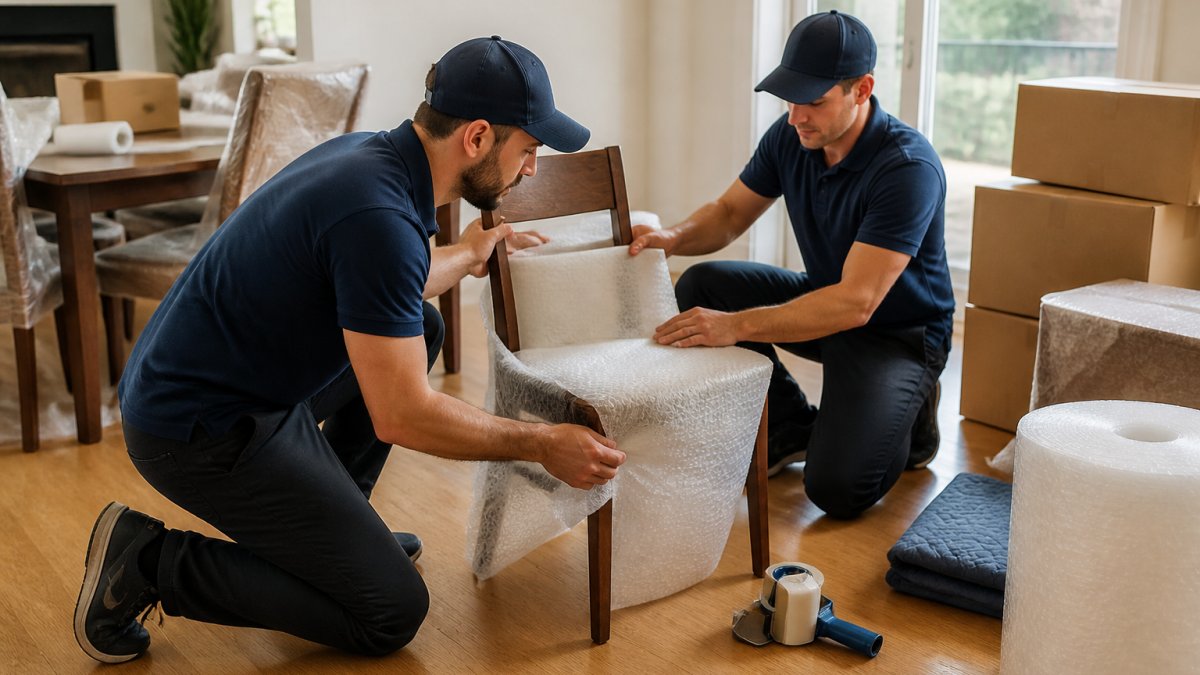
- Packing and wrapping. Boxes are packed by room, furniture is wrapped, and hardware gets bagged and labelled.
- Strategic loading. Heavy items go low and forward, fragile pieces are braced, and the load is strapped.
- Transport. Goods are secured for the drive, whether it is a local move or a long-distance relocation.
- Unloading and placement. Items come off in reverse order, with furniture placed where you want it.
- Unpacking. Many companies offer unpacking services for kitchens, bedrooms, and home offices.
A common mistake is assuming the crew only lifts. The planning and labelling are what prevent damage.
Professional Movers vs DIY Moving: An Honest Comparison
Professional movers trade money for time, safety, and reduced risk; DIY moving trades those for control and lower upfront cost. Neither wins universally, and the only fair comparison is total cost against total effort, not the invoice against the truck rental. If you are deciding between hiring a crew and calling in friends, this professional movers versus friends help comparison lays out the trade-offs.
| Factor | Professional Movers | DIY Move |
|---|---|---|
| Upfront cost | Higher, quoted in advance | Lower per line item, but adds up fast |
| Time required | One scheduled day | Multiple days of prep, packing, and driving |
| Physical strain | Handled by the crew | Falls on you and everyone you can recruit |
| Damage risk | Lower with trained handling and proper materials | Higher without experience or equipment |
| Equipment | Truck, dollies, blankets, straps included | Rental, blankets, and supplies purchased separately |
| Hidden costs | Access conditions, materials, travel time | Fuel, mileage fees, cleaning, replacement of broken items |
| Stress level | Managed by a crew lead | Rests entirely on you |
Building the Real DIY Baseline
A DIY move is rarely just a truck rental. The true baseline stacks several costs that are easy to underestimate when you are comparing against a single quote:
- Truck rental, often priced by the day plus a per-distance charge, with fuel on top
- Packing supplies, boxes, tape, bubble wrap, stretch wrap, and furniture blankets, bought in quantities you will overestimate
- Equipment rentals for items you do not own, such as appliance dollies or furniture straps
- Recruited help, whether paid in cash, pizza, or favors you will owe later
- Replacement cost for anything that breaks in transit without professional packing
- Lost time, including a day or more of unpaid leave if you move on a weekday
Add those up and the gap between DIY and a professional quote narrows more than most people expect, especially for a two- or three-bedroom home with stairs.
When DIY Moving Still Makes Sense
DIY is the better call in a few clear situations:
- A studio or one-bedroom with little furniture and no large appliances
- A short intra-city move where you can make several trips in a personal vehicle
- A flexible timeline with no lease gap pressure and no fixed move-out date
- A tight budget where the savings genuinely outweigh the effort, and you have willing, able help
- A household with no oversized or awkward items, no piano, no large sectional, no oversized appliances
Watch out: DIY goes wrong fastest when a move involves stairs, a tight parking situation, a narrow stairwell, or one heavy item you cannot safely lift with two people. If your move includes a piano, a large sectional, or a fourth-floor walk-up, the math usually flips toward hiring.
The honest test is not “can I afford movers?” but “what does my DIY move actually cost in money, time, and risk?” Build the full baseline before you decide.
How Professional Packers Protect Fragile Items and Valuables
Protection starts with materials, not strength. For a step-by-step walkthrough, see how to pack fragile items for moving.
The technique matters as much as the supplies. Glasses get wrapped individually and packed upright. Plates go on edge, never flat. Screens and mirrors travel in rigid crates. Hardware from disassembled furniture goes into labelled bags taped to the piece itself.
How to Prepare for Professional Movers Before They Arrive
Preparation is where customers save the most time and money. Clear walkways, empty the fridge, and separate anything you are moving yourself. Label rooms clearly so boxes land in the right place.
A short checklist before the crew arrives:
- Confirm parking access and elevator booking if you are in a condo
- Pack personal documents, medication, and valuables separately
- Disconnect appliances and drain hoses
- Remove wall art and anything fragile from shelves
- Set aside cleaning supplies and a box of day-one essentials
- Confirm the start time and expected duration with the company
Questions to Ask a Moving Company Before You Book
Ask about crew status, quote structure, and what happens if something goes wrong. A moving company review checklist helps you organize the answers and vet each company consistently. The answers tell you more than any review page.
- Are your crews employees or subcontractors?
- Is the quote binding, and what could change it?
- What is included in packing services versus loading only?
- How do you handle claims if an item is damaged?
- Do you carry liability coverage?
- How much notice do you need for booking?
- Can you handle a same-day or short-notice move?
Ask for the answers in writing. A company that hesitates on the claims question is telling you something.
What a Transparent Moving Quote Should Include
A transparent quote states the scope, the rate structure, and the conditions that could change the total. To judge whether a quote is transparent, it helps to understand flat rate versus hourly moving quotes. Anything vague about access, stairs, or packing materials will resurface on moving day, usually as a higher final bill.
What Actually Drives the Price
Most quotes move up or down based on a handful of variables. Understanding them lets you compare quotes fairly instead of chasing the lowest number:
- Volume and weight, how many rooms, how much furniture, and how heavy the load is
- Distance, local moves are usually priced differently from long-distance relocations
- Access, stairs, elevators, long carry distances from door to truck, and tight parking
- Packing scope, full packing, partial packing, or loading only
- Specialty handling, oversized furniture, appliances, or items needing crating
- Timing, peak moving season and short-notice bookings typically cost more
- Crew and truck size, a larger crew finishes faster but bills more per hour
Line Items a Transparent Quote Should Show
Look for these stated clearly, not buried in a single lump sum:
- Rate structure: flat rate or hourly, stated explicitly
- Crew size and truck size included in the quote
- Packing materials itemized or explicitly excluded
- Access conditions: stairs, elevator, long carry distance
- Travel time or mileage, if applicable
- Valuation or liability coverage and its limits
- Payment terms and deposit policy
How to Compare Two Quotes Side by Side
Comparing quotes is only meaningful when the scope matches. A common pattern is that the lowest quote covers loading only, while a higher quote includes packing materials and unpacking, so the two are not the same service.
- Confirm the scope matches, same rooms, same packing level, same access conditions
- Check whether the quote is binding or non-binding, and what could change it
- Compare the crew and truck size, since a smaller crew takes longer on an hourly quote
- Ask each company to explain any line item you do not understand in writing
- Treat a quote far below the others as a question, not a win, ask what it excludes
A single number with no breakdown is not a quote, it is an estimate waiting to grow. Ask for the detail before you compare totals.
If a quote lists a single number with no breakdown, ask for the detail.
Request a Quote and Lock In Your Moving Date
The gap between a smooth move and a difficult one usually comes down to preparation and the crew you choose. If your move involves heavy furniture, fragile pieces, or a tight timeline, booking a professional team early is the simplest risk reduction available. At On Time Moving Delivery, we offer flexible scheduling, comprehensive packing and unpacking services, and specialized support for seniors, all with a transparent process from quote to delivery.
Get started with On Time Moving Delivery and request a quote to confirm your moving date.
Frequently Asked Questions
What are the benefits of hiring professional packers and movers?
The main benefits are time savings, less physical strain, and better protection for your belongings. A trained crew arrives with packing materials, wraps furniture, loads the truck securely, and often unpacks at the destination. That means fewer damaged items, less stress, and a move that finishes in hours rather than weeks of evenings and weekends. For anyone with a tight schedule, a physical limitation, or high-value household goods, the convenience usually outweighs the cost.
Is it worth hiring professional packers for a move?
It depends on your time, health, and how much you own. Professional packers make the most sense for large homes, tight timelines, stairs or elevators, and households with fragile items or valuables. If you live in a small apartment, have plenty of free time, and own mostly durable furniture, a DIY move can work. Weigh the cost of packing supplies, truck rental, and your own hours against a flat-rate quote before deciding.
How far in advance should you book professional movers?
Book two to four weeks ahead for a local move and four to eight weeks for a long-distance relocation, especially at month-end when demand peaks. Same-day and short-notice moves are sometimes possible, so call and ask about availability rather than assuming you are too late. Confirming your date early also gives you time to sort belongings, arrange parking or elevator access, and pack personal essentials.
What are red flags to watch for when hiring movers?
Watch for quotes given over the phone without a walkthrough, demands for large cash deposits, no written agreement, and vague answers about what the quote covers. Get the pickup and delivery windows in writing. A mover who cannot explain charges clearly or pressures you to sign on the spot is worth walking away from.
