
Last Updated: October 29, 2026
Quick Summary
Moving large furniture safely alone starts with measuring the route before you lift anything, since no technique fixes a piece wider than the doorway. Use a dolly, sliders, and lifting straps, empty every drawer, and apply the one-hand test: if you cannot lift a corner with one hand, it is a two-person job.
- Walk the full route first and note every turn, threshold, and stair.
- Lift with your legs, keep the load close, and never twist while carrying.
- Remove drawers, doors, and legs to cut weight before the piece moves.
- Going down stairs, step backward and keep the load tilted toward your body.
- Stop and get help if the route needs a turn that blocks your view.
Table of Contents
- Plan the Route Before You Lift Anything
- How to Protect Hardwood Floors During a Move
- Best Furniture Moving Tools for Solo Movers
- Safe Lifting Techniques for Heavy Furniture
- Reduce Weight Before You Move Large Furniture
- Stair and Landing Techniques for One Person
- When to Stop and Ask for Help
- Request a Quote for Professional Furniture Moving
- Frequently Asked Questions
Plan the Route Before You Lift Anything
Most furniture damage happens before anyone lifts a thing. It happens when a couch meets a doorway that was never measured. Learning the basics of moving large furniture safely alone starts with a tape measure, not a dolly.
Walk the full route first. Start at the item, end at the truck or new room. Note every turn, threshold, and stair. Then write down three numbers:
- The width and height of the furniture
- The narrowest doorway on the route
- The tightest corner or hallway turn
If the item is wider than the doorway, it does not fit. No technique fixes that. For awkward pieces, our guide on how to move heavy furniture walks through the full step-by-step process.
Measure Doorways, Hallways, and Tight Spaces
Doors are rarely the problem. The space just past them is. A standard interior door clears most furniture, but a hallway that turns right after the threshold traps anything long.
Measure the door opening, then subtract the door itself if it does not come off. Many interior doors can be removed from their hinges, which can add some clearance.
Clear Obstacles and Protect Corners
Clear the route completely before the lift. That means:
- Move rugs, plants, and floor lamps out of the path
- Remove wall art near tight turns
- Tape padding to corners the furniture will pass
A clear route means you never stop mid-carry to kick something aside. Stopping is how backs get hurt.
How to Protect Hardwood Floors During a Move
Grit under a dragged leg can scratch a hardwood floor, so it is best to avoid dragging furniture across it.
Protect hard floors in layers: a felt pad under every furniture leg, then a runner or moving blanket along the route.
Sweep the route first, so grit is not trapped under a slider.
For deeper guidance on avoiding damage across the whole move, read our breakdown of how to avoid moving damage.
Best Furniture Moving Tools for Solo Movers
The right gear does the heavy work so your body does not have to. A solo mover with a dolly and straps can shift items that would otherwise need two people.
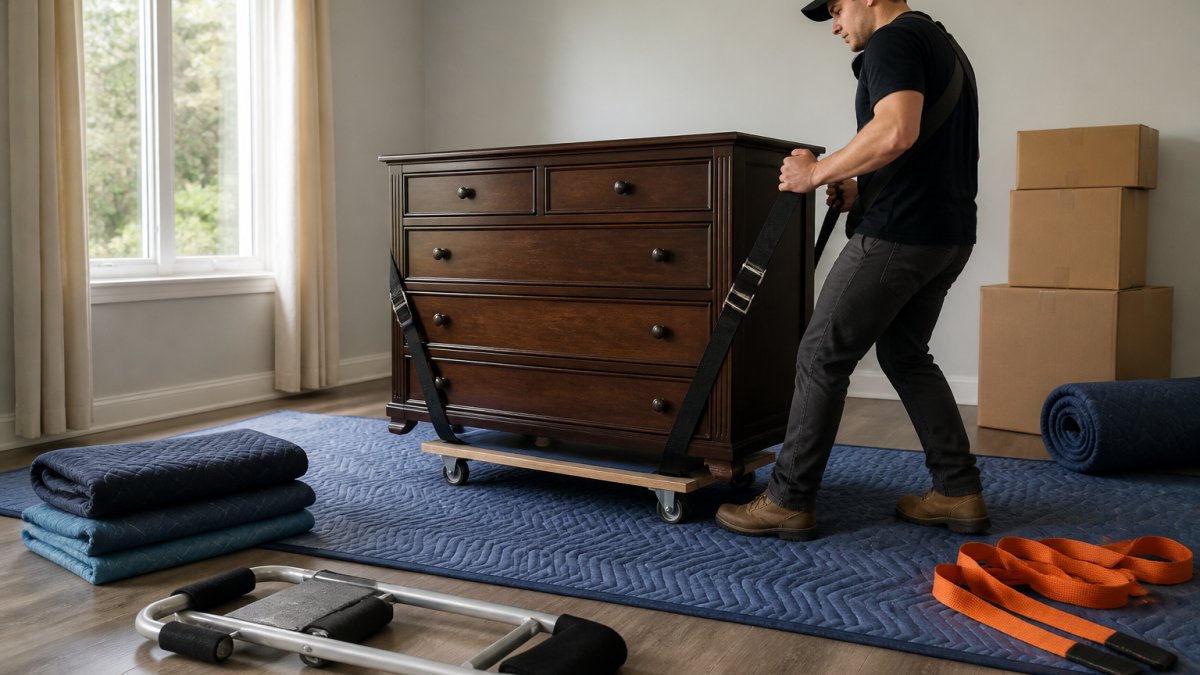
You do not need much. Four tools cover most solo moves:
| Tool | What It Does | Best For |
|---|---|---|
| Furniture dolly | Rolls heavy items on a platform | Dressers, boxes, appliances |
| Hand truck | Tilts and rolls tall items | Fridges, cabinets, stacked boxes |
| Lifting straps | Spreads weight across your body | Stairs, long carries |
| Furniture sliders | Glide items on hard floors | Couches, tables, short shifts |
Dollies, Sliders, and Straps: What Each One Does
A furniture dolly is a flat platform on four wheels. You tilt the item onto it and roll. Best for anything boxy and heavy, but it needs a clear, flat path and struggles on stairs.
Furniture sliders are smooth discs or pads that go under legs. They glide on hard floors but dig into carpet. Use them for short shifts, not long hauls.
Lifting straps loop under the load and over your shoulders, moving weight off your lower back and onto your legs and core.
Safe Lifting Techniques for Heavy Furniture
Good lifting technique is the difference between a moved couch and a strained back. The rules are simple, and they work.
- Lift with your legs, not your back. Bend your knees, keep your spine straight (CCOHS: Lifting).
- Keep the load close to your body. A load held at arm’s length puts far more strain on your spine (CCOHS: Lifting).
- Never twist while carrying. Turn with your feet instead.
Set a hard rule: if you cannot lift the item’s corner off the floor with one hand, it is a two-person job.
Reduce Weight Before You Move Large Furniture
The lightest furniture is empty furniture, and that is the first rule of moving large furniture. Every drawer you pull is weight you do not carry.
Strip each piece before it moves:
- Remove all drawers and carry them separately
- Empty shelves, cabinets, and compartments
- Take off doors, legs, and removable hardware
Removing contents and parts can noticeably reduce a dresser’s weight.
Disassemble, Empty, and Secure the Load
Disassemble anything with a removable base, legs, or top. A table with the legs off is a flat board, not a puzzle.
Empty every compartment, then check again. A forgotten book in a drawer becomes a projectile on the stairs.
Secure the load before it moves. Wrap drawers shut with stretch wrap or tape so they cannot slide open mid-carry.
Stair and Landing Techniques for One Person
Stairs are where solo moves go wrong. The load blocks your view, your footing is uneven, and there is no room to set it down. The staircase, not the doorway, is the true test of whether a piece moves alone.
On a staircase, the load sits at an angle, your center of gravity shifts, and the handrail is often the only thing between you and a fall.
Set Up Before the First Step
Do these checks at the top of the stairs, not halfway down:
- Strap the load to a dolly or use lifting straps before you start. Loose loads shift on the tilt.
- Clear the stairs completely. No shoes, no boxes, no loose runner.
- Check the handrail. If it wobbles, do not trust it with your weight.
Going Down: Backward, Tilted, Controlled
Going down is the harder direction for one person because gravity pulls the load away from you.
- Face the stairs, grip the load, and step down backward one step at a time.
- Keep the load tilted toward your body so its weight stays over your feet, not out over the drop.
- Keep the load low. A high carry on stairs blocks your view and raises your center of gravity.
- Never carry a load that blocks your view of the steps. If you cannot see your feet, stop and reset.
- At the landing, set the load down and reset your grip before the next flight.
A common mistake is letting the load drift forward on the descent because it feels lighter. It is not lighter; it is further from your base, and that is how backs and knees fail.
Going Up: Forward, Leaning In, Low
Going up is easier on the grip but harder on the legs. Lean into the stairs, keep the load low and close, and drive with your legs rather than pulling with your back. Take one step at a time and do not rush the top landing, where the load has to clear the last riser and the floor edge at once.
Landings and Corners
Corners on landings are the hardest part. Pivot the load on its corner rather than swinging it wide. Set the load down, walk around it, and re-grip from the new angle. If the turn needs two people to clear the wall, it needs two people. No strap fixes a turn that blocks your view.
If you cannot see your feet, the load is too high or too wide for a solo stair carry. Set it down and reassess before the next step.
Item-Specific Stair Notes
- Sofas: Strap the sofa vertically to a dolly if the stairwell is straight. On a turn, the sofa’s length is the enemy; measure the diagonal before you commit.
- Mattresses: A mattress bends, which helps on turns but hurts on landings because it can fold and trap your hands. Keep your grip on the edges, not the face.
- Dressers: Empty every drawer first. A dresser that loses a third of its weight on the stairs is a different job.
If the stairwell is narrow, the turn is blind, or the piece is wider than the tightest landing, stop.
When to Stop and Ask for Help
Knowing your limit is a skill, not a weakness. Some furniture should never move solo, no matter how good your technique.
The One-Hand Test
Set a hard rule for yourself: if you cannot lift the item’s corner off the floor with one hand, it is a two-person job. This is a rough test, not a measurement, but it filters out most pieces that will hurt you on a slope or a stair.
Stop Conditions
Stop and call for help if any of these are true:
- The item weighs more than you can safely control on a slope or stair.
- The route needs a turn that blocks your view.
- The piece is wider than the tightest doorway or landing.
Pushing past these limits is how people get hurt.
Item-Specific Limits
- Sofas and sectionals: A three-seat sofa is a two-person lift on flat ground and a no-go solo on a turn. Sectionals come apart; take them apart.
- Mattresses: A queen or king mattress is light but floppy. Solo, it is a stair hazard because it folds and traps hands. Use a mattress bag and a second person on stairs.
- Dressers and wardrobes: Empty first. A full dresser is a two-person lift; an empty one is often a solo dolly job.
Safer Alternatives When Standard Lifting Is Not an Option
Not every reader can use standard lifting technique, and that is not a reason to skip the move. Alternatives:
- Sliders and a pry bar: For short shifts on hard floors, sliders let you move a piece without lifting it. Sweep first; grit under a slider scratches a finished floor in one pass.
- A dolly and a ramp: For a single step or a threshold, a ramp turns a lift into a roll.
- Furniture straps with a second person: Straps spread weight, but they do not replace a second set of hands on stairs.
Set your limit before moving day, not on the stairs.
If you are weighing whether to call in help, our comparison of professional movers versus friends lays out the trade-offs clearly.
Request a Quote for Professional Furniture Moving
Some moves are a solo job. Others are not, and pretending otherwise costs more than hiring help.
On Time Moving Delivery offers residential and commercial moving services across Ontario, with flexible scheduling and a transparent process.
If you are ready to hand off the heavy lifting, request a quote and get a clear plan for your move.
Frequently Asked Questions
What tools do I need to move heavy furniture by myself?
At minimum, you need a furniture dolly or hand truck, moving straps, furniture sliders, and protective padding for edges and floors. A tape measure helps you check doorways and pathways before you start. For bulky items, a four-wheel dolly distributes weight better than a two-wheel hand truck. Keep a utility knife and stretch wrap on hand to secure drawers and doors during transport.
Is it safe to move large furniture alone?
It can be safe for smaller or lighter pieces if you plan the route, use proper equipment, and follow safe lifting techniques. However, moving large furniture alone becomes risky when a piece is too heavy to tilt and control, when stairs are involved, or when the pathway is tight. If you cannot keep the load balanced or see your footing, stop and ask for help or book professional movers.
How can I move a heavy dresser alone without scratching floors?
Empty the drawers first to reduce weight, then place furniture sliders under the legs or corners. Lift one end slightly and slide the sliders underneath, then push the dresser slowly across the floor. For hardwood, use felt-backed sliders and lay down a moving blanket or hardboard panel along the route. Avoid dragging the dresser directly on hard floors, which can leave deep scratches.
What should I do if a piece of furniture is too heavy to lift alone?
Do not force the lift. Instead, reduce the weight by removing drawers, shelves, and contents, or disassemble the piece if possible. Use a dolly or sliders to move it without lifting. If it still will not budge safely, ask a neighbor or hire professional movers. Attempting a solo lift that is beyond your strength is the most common cause of back injury during a move.
Moving large furniture alone is possible when you plan the route, use the right tools, and respect your limits. When a piece is too heavy or a stairwell too tight, that is your signal to call in a team that does this every day. Get started with On Time Moving Delivery and move your furniture without the strain or the damage.
