
Last Updated: October 28, 2026
Quick Summary
A checklist for moving house in Ontario should run on a fixed timeline: book movers and set your budget eight to six weeks out, declutter and pack four to two weeks out, then confirm booking, building access and payment in the final week. On moving day, walk the crew through the home, note fragile items, and take meter readings and photos before you lock up.
- Get quotes in writing and confirm what each quote includes before booking your movers.
- Declutter room by room into keep, donate and toss piles before you start packing.
- Label every box on the top and one side with the room and a short contents note.
- Update your driver’s licence, vehicle registration and health card address through ServiceOntario.
- Set up Canada Post mail forwarding to start on your move date and run for at least a few months.
Table of Contents
- Your Moving Timeline Checklist: 8 Weeks to Moving Day
- The Printable Moving Checklist You Can Post on the Fridge
- Documents Needed When Moving in Ontario
- Your Change of Address Checklist: Who to Notify
- Condo and Apartment Move Coordination: Elevators, Parking and Building Rules
- Seasonal, Renter and Household Planning That Checklists Miss
- Request a Quote and Lock In Your Move Date
- Frequently Asked Questions
Your Moving Timeline Checklist: 8 Weeks to Moving Day
A checklist for moving house in Ontario works best when it runs on a fixed timeline rather than a pile of good intentions. Below is a moving timeline checklist, from eight weeks out to the morning the truck arrives.
Eight to Six Weeks Out: Book and Budget
Book your movers and set your budget first, because everything else depends on both. Get quotes in writing, confirm what each quote includes, and ask about availability for your preferred dates. Peak weekends fill up fastest.
Build a simple budget sheet with four columns: moving company, packing supplies, utility setup and connection fees, and a contingency line. Then start the paperwork. If you rent, Ontario’s residential tenancy guidance from the provincial government sets out the notice a tenant must give before ending a tenancy, so check your lease dates before you confirm a move date. For a fuller cost picture, see how much a move costs in Ontario.
Four to Two Weeks Out: Declutter and Pack
Declutter before you pack, not while you pack. Every item you sell, donate or recycle is an item nobody has to carry. Work room by room and sort into three piles: keep, donate, toss.
Then pack in this order: out-of-season clothing, books and decor, kitchen extras, and finally everyday items. Our step-by-step moving prep checklist covers the packing sequence in more detail if you want it beside you.
The Final Week and Moving Day
Confirm your booking, your building access and your payment method in the final week. Pack a clearly labeled essentials box and keep it with you, not on the truck.
On moving day, walk the crew through the home before loading starts, point out anything fragile, and do a final sweep of closets, cabinets and the garage.
Here is the moving timeline at a glance, from eight weeks out to moving day.
| Phase | What to do |
|---|---|
| Eight to six weeks out | Book movers, get written quotes, set budget |
| Eight to six weeks out | Check lease notice dates before confirming move date |
| Four to two weeks out | Declutter room by room into keep, donate, toss |
| Four to two weeks out | Pack in order: out-of-season, books, kitchen extras, everyday items |
| Four to two weeks out | Label every box on top and one side |
| Final week | Confirm booking, building access and payment method |
| Final week | Pack a labeled essentials box to keep with you |
| Moving day | Walk crew through home, note fragile items, take meter readings and photos |
The Printable Moving Checklist You Can Post on the Fridge
A printable moving checklist is simply the timeline above condensed onto one page you can see daily. Print it, stick it on the fridge, and tick items off as they’re done.
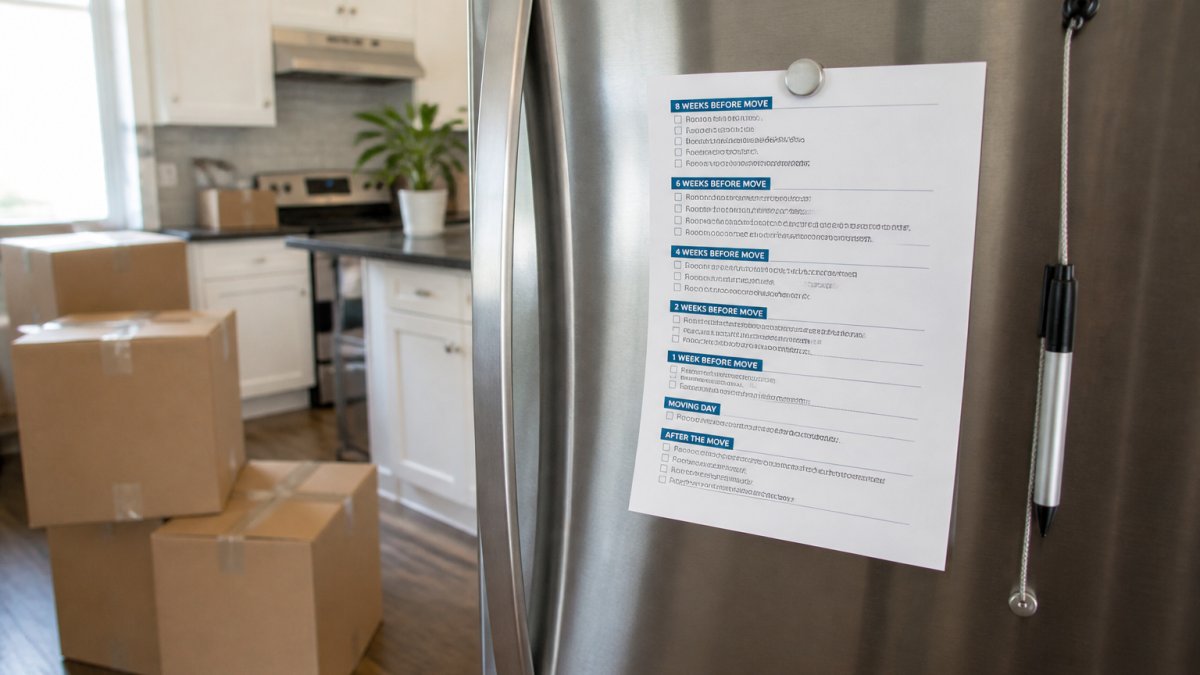
Keep the page short. Three columns work well: task, deadline, done. Group tasks under the same phases as your timeline so the page matches how you actually work.
Documents Needed When Moving in Ontario
The documents needed when moving in Ontario fall into two groups: identity and property paperwork. Gather both before moving week so nothing goes missing in a box.
Property paperwork: lease or purchase agreement, property title documents, home inspection reports, mortgage papers, warranties, maintenance records, and recent utility bills.
Scan everything into one folder in cloud storage and keep the originals in a single labeled folder that travels with you.
Your Change of Address Checklist: Who to Notify
A change of address checklist should cover government, finance, health and household services, in that order. Start with the items that carry penalties or waiting periods if missed, then work outward to the accounts that only cause inconvenience.
Provincial government updates first
These are the items most likely to trip up a move, because each has its own process and its own turnaround.
- Driver’s licence and vehicle registration. Address changes for a driver’s licence, vehicle permit and licence plate sticker are handled through ServiceOntario. You can update online or in person, and the address on file affects where renewal notices and plate stickers are mailed. Update this before your renewal date, not after.
- Health card. Address changes for an Ontario health card are also handled through ServiceOntario. Keep the card itself valid, a move does not require a new card, but the address on file should match where you actually live so correspondence reaches you.
- Canada Revenue Agency. Update your address through CRA My Account or by phone. This matters for benefit and credit payments, which are calculated using the address on file. Do it as soon as you have a confirmed new address, not after you’ve unpacked.
ServiceOntario address change guidance
Finance, health and household services
Once the government items are in motion, work through the rest in a single sitting:
- Banks, credit cards and any lender, update the address on every account, not just the primary one
- Insurance provider for home and auto, a move can change your premium, so confirm the policy address matches the new home
- Employer payroll and benefits, payroll, group benefits and pension administrators each keep their own record
- Family doctor, dentist and any specialists, ask whether the practice is accepting patients at your new address, and request records transfers early
- Utilities: hydro, gas, water, internet and phone, schedule disconnection at the old home and connection at the new one for the same day where possible
- Subscriptions, deliveries and loyalty programs, the low-stakes items that are easy to batch
- Schools, if applicable, confirm catchment and registration requirements before the school year starts
- Friends, relatives and anyone who sends you physical mail
The Canada Mortgage and Housing Corporation’s change of address checklist groups these by recipient type, which is a useful cross-check against your own list.
Build the list in a spreadsheet with three columns: recipient, method (online, phone, in person), and date completed. The government items belong at the top, because they have the longest processing times and the highest cost of a missed notice.
What to keep on hand while you update
Have your new address, move date, and account numbers ready before you start. Most online updates take a few minutes each; the delay is almost always hunting for the reference number. Do the government updates in one block, the financial updates in a second block, and the household services in a third, batching by method is faster than batching by room.
Condo and Apartment Move Coordination: Elevators, Parking and Building Rules
Condo and apartment moves succeed or fail on building logistics. Book the elevator and loading area with your property manager before you confirm your movers, because a crew that arrives to a blocked lobby loses hours.
Ask three questions: what deposit the building requires for the elevator, what hours moves are permitted, and where the truck can legally park. Get the answers in writing.
If you’re moving within a building, read our guide to booking movers for a condo move for the specific sequence.
Seasonal, Renter and Household Planning That Checklists Miss
Most checklists ignore the conditions that actually make a move hard. Four deserve their own line, because each changes what you do in the final two weeks.
Season and weather
A move in January and a move in July are different projects. Winter moves need cleared paths, floor protection and a timing buffer, because a snowstorm can push a crew back by hours and a frozen walkway is a liability. Summer moves need heat and rain contingencies: water bottles for the crew, cardboard that stays dry, and a plan for keeping the truck’s ramp from becoming a slip hazard. Our winter moving guide covers salting walkways and protecting floors in detail.
Renters versus owners
Renters and owners have different legal obligations, and the checklist should split them.
If you rent: confirm your notice period in writing before you book movers. Ontario’s residential tenancy guidance from the provincial government sets out the notice a tenant must give before ending a tenancy, and the required form depends on why you are leaving.
If you own: the move is tied to the closing date, not to your preferred weekend.
Condo and apartment building logistics
If you are moving into or out of a building, the building’s rules set the schedule, not your movers. Book the elevator and loading area with your property manager before you confirm the crew, because a blocked lobby costs hours. Ask what deposit the building requires for the elevator, what hours moves are permitted, and where the truck can legally park, and get the answers in writing.
Vulnerable household members
Children, pets and seniors need a plan for moving day itself, not just a note to “keep them safe.” Decide who supervises them, where they go while the truck is loaded, and what familiar items travel with them rather than on the truck. For pets, that means a carrier, food, water and a quiet room at the new home. For children, it means a bag with a change of clothes and a favorite toy.
The common thread across all four is that the move is not just about the boxes. The season, the lease or closing date, the building’s rules and the people in the household each set a constraint that a generic checklist misses. Write those constraints down before you book anything.
Request a Quote and Lock In Your Move Date
Requesting a quote is the step that turns a checklist into a booked move. Have your dates, addresses, and a rough room count ready before you call, and ask what the quote includes.
Watch out: a phone estimate with no written confirmation is not a booking. Get the scope, the date and the inclusions in writing before you pay anything.
At On Time Moving Delivery, we offer flexible scheduling, same-day availability, and a transparent moving process. Our team handles packing and furniture with care. Request a free moving quote and lock in your date.
Frequently Asked Questions
What should I do first when planning a move in Ontario?
Set your move date and budget before anything else, then book your movers. Good companies fill up fast, so confirm availability early and get a written quote that lists what is included. From there, start the decluttering and packing process room by room. Building a moving binder with your timeline, documents and contact list keeps every task in one place and makes the rest of the checklist far easier to follow.
How far in advance should I start preparing to move house?
Start about eight weeks before your move date if you can. That gives you time to book movers, sort through belongings, gather quotes and arrange building access. If you are renting, review your lease notice period first, since Ontario tenancy rules set how much notice you must give.
What documents do I need to gather when moving in Ontario?
Collect identification, your lease or property title, home inspection reports, warranties, maintenance records and medical records. Keep them in one labeled folder that travels with you rather than in the moving truck. You will also want your driver’s licence and vehicle permit on hand for address updates after the move. Having these ready means you can update accounts and services without hunting through boxes later.
What should I keep with me on moving day?
Pack an essentials box that stays with you: toiletries, a change of clothing, medications, phone chargers, important documents, keys and identification. Add snacks, water and basic cleaning supplies for the first night. This box should not go on the truck, because you may not see the truck’s contents for hours. Label it clearly and keep it in your car so the first evening in your new home is manageable.
What should I do after moving into a new home?
Unpack the essentials first, then confirm utilities are active and test smoke alarms. Update your address with banks, subscriptions, your insurance provider and government services if you have not already. Check the home for any damage noted during your pre-move inspection and keep receipts for anything you buy. Within the first week, locate the nearest pharmacy, grocery store and transit stop so daily routines settle quickly.
Moving house in Ontario goes smoothly when the timeline does the thinking for you. If you want a crew that shows up on schedule and treats your belongings carefully, get started with On Time Moving Delivery and book your move date with confidence.
